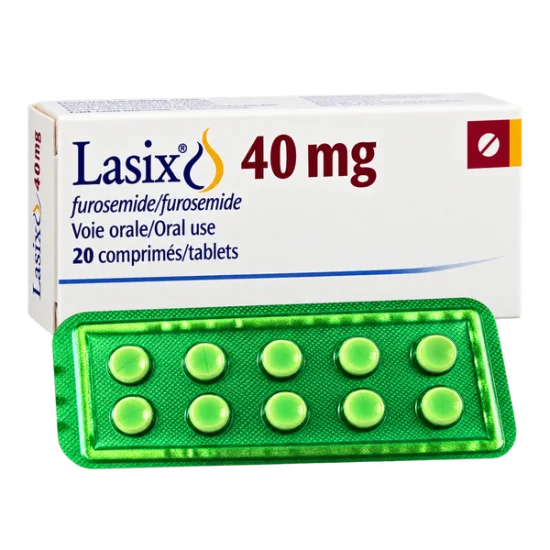
I used Lasix 40 mg for swelling related to a kidney problem. The urination started within a few hours, and my shoes felt less tight after several days. I needed to plan bathroom breaks during work, which was the main inconvenience.
It increases urinary sodium and water loss, helping reduce oedema and circulatory fluid overload. Lasix is used when fluid accumulation is clinically significant or when increased urinary sodium excretion is required as part of blood-pressure management.
Overview
Furosemide, the active ingredient of Lasix, is a high-ceiling loop diuretic supplied as oral tablets. Lasix is prescribed for adults with fluid retention related to cardiac, hepatic, or renal disease and for selected cases of hypertension. How much to use and how often to take it depend on the purpose of treatment and are agreed with a doctor or pharmacist.
Dosage and administration
- Dose: The amount to take is agreed with a doctor or pharmacist according to the purpose of treatment.
- Frequency: How often to take the tablets is agreed with a doctor or pharmacist.
- Timing: The time of day and whether to take the tablets before or after meals should follow the prescribed plan.
- Duration: The treatment duration is determined by a doctor or pharmacist according to the clinical need.
- Route: Take the tablets by mouth.
Formulation
Lasix tablets contain furosemide, also called frusemide. Furosemide belongs to the loop diuretic class, sometimes described as a high-ceiling diuretic because it can produce substantial sodium and water excretion when clinically indicated. The oral route is used for ongoing treatment when a patient can take medication by mouth.
The product presentation contains:
- Active ingredient: furosemide
- Dosage form: oral tablet
- Pack presentation: 20 tablets
- Pharmacological class: loop diuretic
- Route: oral use
Lasix is a prescription-only treatment. How much to use and how often to take it depend on the purpose of treatment and are agreed with a doctor or pharmacist. Health Canada and the European Medicines Agency describe furosemide as a medicine requiring careful clinical assessment because excessive diuresis can disturb hydration and electrolytes [1].
How it affects the body
Furosemide acts mainly in the thick ascending limb of the loop of Henle, a segment of the nephron responsible for reclaiming filtered sodium and chloride. It inhibits the sodium-potassium-chloride cotransporter, reducing reabsorption of these ions into the bloodstream.
- Furosemide reaches the renal tubule through active secretion.
- It blocks sodium and chloride reabsorption in the loop of Henle.
- More sodium remains within the tubular fluid.
- Water follows the retained sodium.
- Urine volume rises and circulating fluid volume falls.
This mechanism explains why Lasix is more potent than mild “water pills” or herbal products marketed for temporary fluid loss. The medicine acts at a nephron site capable of handling a large proportion of filtered sodium. It also increases urinary loss of potassium, calcium, magnesium, and chloride, which explains the need for laboratory monitoring.
Therapeutic indications
Lasix reduces excess extracellular fluid. Doctors use it when fluid accumulation is clinically significant or when increased urinary sodium excretion is required as part of blood-pressure management.
Common medical contexts include:
- Oedema associated with congestive heart failure
- Fluid retention linked to kidney disease
- Oedema associated with liver disease
- Pulmonary congestion caused by fluid overload
- Hypertension in selected patients
- Fluid overload requiring a potent diuretic response
Peripheral oedema may appear as swelling around the ankles, lower legs, or feet. Pulmonary congestion can cause breathlessness, reduced exercise tolerance, or difficulty lying flat. These symptoms can have several causes, so the decision to use Lasix depends on examination, renal function, blood pressure, weight changes, and laboratory results.
Furosemide may be used alone or alongside other medicines. A loop diuretic can lower fluid volume rapidly, while other treatments may address the underlying heart, kidney, liver, or vascular condition. The World Health Organization classifies furosemide within the diuretic group used in cardiovascular and renal care, and NICE addresses loop-diuretic use in related conditions [2].
Common mistakes
- Taking a missed dose late in the evening without considering sleep disruption
- Doubling the next dose after forgetting one
- Stopping treatment suddenly because urination increases
- Ignoring muscle cramps, weakness, confusion, or faintness
- Using ibuprofen regularly without reporting it
- Taking potassium supplements without a documented reason
- Drinking excessive amounts of fluid to compensate for urination
- Restricting salt or water more aggressively than prescribed
- Failing to mention vomiting, diarrhoea, or heavy sweating
- Treating new breathlessness as ordinary swelling
If a dose is missed, the correct action depends on the time of day, the treatment schedule, and the indication. The patient should use the agreed plan rather than automatically doubling the next dose. A late dose may be unsuitable for someone who needs to drive, operate machinery, or sleep through the night.
Reasons not to use it
Lasix is not suitable for everyone. This medication is not for you if you have complete absence of urine production that does not respond to treatment, severe dehydration, or a serious electrolyte depletion that has not been corrected. A previous severe allergic reaction to furosemide also requires avoidance.
Doctors assess the following before prescribing or increasing the dose:
- Urine output and kidney function
- Blood pressure and symptoms of volume depletion
- Serum sodium, potassium, magnesium, calcium, and bicarbonate
- Liver disease and risk of hepatic encephalopathy
- Diabetes and glucose control
- Gout or raised uric acid
- Previous hearing problems
- Pregnancy or breastfeeding
- Allergy history, including serious reactions to sulfonamide medicines
A sulfonamide allergy does not automatically predict an allergy to furosemide, but a history of severe reactions deserves careful evaluation. The decision depends on the nature of the previous reaction and available alternatives.
Pregnancy requires an individual risk assessment. Furosemide is not used routinely to treat ordinary pregnancy-related swelling, because physiological fluid changes in pregnancy differ from pathological oedema. Breastfeeding also requires a clinical decision, since strong diuresis may affect milk production.
Excessive sodium restriction, heavy sweating, vomiting, diarrhoea, or poor fluid intake can increase the risk of volume depletion. Older adults may be more sensitive to postural dizziness and falls.
When this is not for you
Tell the prescriber about vomiting, diarrhoea, reduced drinking, or a recent fall before the Lasix dose is increased. These details can change the risk assessment even when the prescribed medicine has not changed.
Possible side effects
Lasix can cause unwanted effects because it changes renal handling of water and minerals. The likelihood depends on dose, treatment duration, kidney function, age, fluid intake, and other medicines.
Common or clinically recognised effects include:
- Increased urination
- Thirst or dry mouth
- Dizziness, especially when standing
- Low blood pressure
- Weakness or fatigue
- Muscle cramps
- Reduced potassium
- Reduced sodium
- Reduced magnesium
- Increased uric acid
- Changes in blood glucose or lipid measurements
- Constipation or gastrointestinal discomfort
Electrolyte depletion may produce symptoms that seem unrelated to a water tablet. Palpitations, cramps, confusion, severe weakness, or marked lethargy can indicate a clinically significant imbalance. People with diabetes may also need closer glucose monitoring because diuretic treatment can affect glycaemic control.
More serious reactions include:
- Severe dehydration
- Acute worsening of kidney function
- Profound hypotension
- Serious electrolyte abnormalities
- Hearing disturbance or hearing loss
- Severe skin reactions
- Blood-cell abnormalities
- Pancreatitis
- Severe allergic reactions
Ototoxicity means injury affecting hearing or balance. It is uncommon with ordinary oral use but becomes more concerning with high doses, rapid intravenous administration, severe kidney impairment, or concurrent ototoxic medicines. The FDA prescribing information for Lasix identifies fluid, electrolyte, renal, and hearing-related risks that require clinical attention [3].
Comparison
Lasix belongs to a different diuretic class from thiazide and potassium-sparing medicines. The best option depends on the cause of fluid retention, kidney function, potassium level, blood pressure, and the wider treatment plan.
| Diuretic category | Main renal action and clinical role |
|---|---|
| Lasix — furosemide | Blocks sodium-chloride reabsorption in the loop of Henle; produces potent diuresis for significant fluid overload |
| Thiazide diuretics | Reduce sodium reabsorption in the distal tubule; commonly used for hypertension and milder fluid retention |
| Potassium-sparing diuretics | Reduce potassium loss through effects in the distal nephron; used in selected conditions and combinations |
Loop diuretics can remain useful when kidney function is reduced, although the required dose and response vary. Thiazide-type medicines may be preferred for uncomplicated hypertension when a strong diuretic effect is unnecessary. Potassium-sparing agents may be selected when preserving potassium is clinically relevant, yet they can cause dangerous hyperkalaemia in susceptible patients.
“Water pills” is a broad everyday term. It can refer to prescription diuretics, but it is also used for low-evidence herbal products. These categories do not have equivalent potency, dosing precision, monitoring requirements, or evidence for treating heart, kidney, or liver-related fluid overload.
A key trade-off is potassium balance. Lasix may lower potassium, while potassium-sparing treatment may raise it. Combining diuretics can be appropriate under supervision, but the combination requires a clear clinical reason and laboratory follow-up.
What doctors say
In clinical practice, doctors usually judge Lasix by several measures rather than urine volume alone. Weight, ankle swelling, breathlessness, blood pressure, kidney function, sodium, potassium, and daily symptoms all contribute to the assessment.
A physician may increase the dose when fluid retention persists, but a higher dose is not automatically better. Too much diuresis can lower circulating volume and reduce kidney perfusion. The goal is sufficient fluid removal without causing symptomatic hypotension, kidney injury, or severe electrolyte loss.
Furosemide can also show a weaker response when intestinal absorption is inconsistent, renal perfusion is poor, or kidney disease is advanced. Some patients need a different schedule or combination approach. These decisions belong to the prescribing clinician because the correct plan depends on the reason for oedema and the current laboratory profile.
Patients often expect the medicine to remove all swelling permanently. Lasix controls fluid accumulation; it does not reverse every underlying cause of oedema. A persistent need for treatment may reflect ongoing heart, kidney, liver, or vascular disease.
Comparison
Common questions
What should I discuss with a doctor before starting Lasix?
Discuss kidney function, urine output, blood pressure, liver disease, gout, diabetes, pregnancy, breastfeeding, hearing problems, and previous allergic reactions. Provide a full list of medicines, including lithium, anti-inflammatory pain relievers, digoxin, corticosteroids, and mineral supplements. Health Canada product information published in 2020 recommends attention to fluid status and electrolyte balance before and during furosemide treatment [4]. This review helps determine whether Lasix is suitable and how monitoring should be arranged.
Can Lasix affect driving, concentration, or machinery work?
Lasix can cause dizziness, blurred vision, weakness, dehydration, or low blood pressure, especially after treatment begins or the dose changes. These effects can impair driving, climbing, or machinery work even when the medicine itself does not directly sedate the brain. The European Medicines Agency discusses these practical risks in safety information for furosemide-containing medicines published in 2018. Do not drive or operate machinery while you feel faint, confused, unusually weak, or unable to concentrate.
Is Lasix used in people under 18?
Furosemide can be used in paediatric medicine for specific indications, but dosing is based on the child’s condition, weight, kidney function, and fluid status. A 40 mg adult tablet should not be given to a child without a clinician’s specific instruction. WHO paediatric prescribing principles published in 2023 support weight- and condition-based dosing rather than using an adult dose by assumption. Treatment in anyone under 18 requires a paediatric prescriber and appropriate monitoring.
What should I do if the expected result does not occur?
Persistent swelling, breathlessness, rapid weight gain, or poor urine response requires clinical reassessment rather than an automatic dose increase. The cause may involve kidney function, disease progression, absorption, treatment timing, sodium intake, or an interacting medicine. The EMA safety framework for furosemide published in 2018 highlights the need to assess renal function and electrolytes when response changes. Seek urgent medical attention for severe breathlessness, chest pain, fainting, confusion, or very little urine.
Do you offer anonymous delivery?
Your order will be securely packed and shipped within 24 hours. This is exactly what your package will look like (images of an actual item sent). It has the size and look of a regular private letter (24x11x0.7 cm) and its contents cannot be seen.
Customer Feedback on Lasix
I took the tablet in the morning for fluid retention. It helped my ankle swelling, but I felt light-headed when standing during the first week. The dose was reviewed after blood tests, and the dizziness became less noticeable.
Lasix reduced the breathlessness and swelling linked to my heart condition. I still had to attend regular blood tests because my potassium changed. It was useful, but I would not change the dose based only on how much urine I passed.
The medicine made me urinate more than expected and disturbed one night of sleep when I took it too late. Moving the timing within the prescribed plan helped. The swelling improved, although it did not disappear immediately.
I used furosemide for several weeks and noticed better ankle swelling. I also had cramps and thirst, so the treatment was reassessed. The main lesson for me was to report those symptoms instead of treating them as normal.
Sources
- Health Canada (2020). Product Monograph: Furosemide Tablets.
- World Health Organization (2023). WHO Model List of Essential Medicines, 23rd List.
- U.S. Food and Drug Administration (2020). Lasix (furosemide) Tablets Prescribing Information.
- Health Canada (2019). Guidance Document: Labelling of Pharmaceutical Drugs for Human Use.