The itching eased within several days and the plaque looked less red. I stopped after the short course, but the area became dry again, so moisturiser became part of my daily routine.
An eczema or psoriasis flare can cause redness, scaling, swelling, and persistent itching. Elocon contains mometasone furoate 0.1%, a potent topical corticosteroid cream for reducing skin inflammation in adults and children when prescribed for an appropriate condition. It acts locally to calm inflammatory signals rather than remove the underlying allergic or autoimmune trigger.
Overview
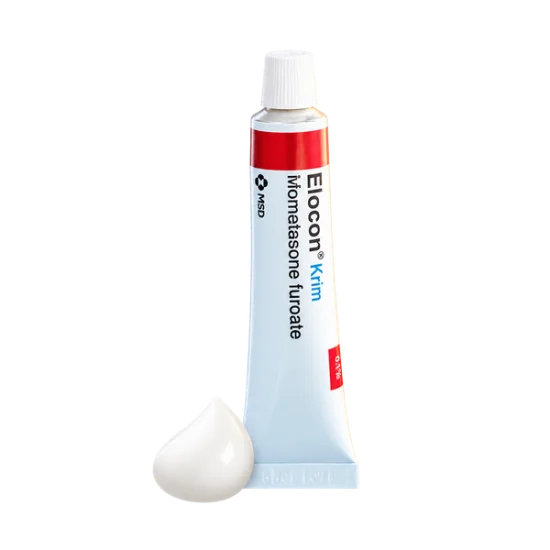
Elocon is a topical cream containing mometasone furoate 0.1%. Mometasone belongs to the corticosteroid family and is used to reduce inflammatory skin symptoms such as redness, swelling, irritation, and itching.
Dosage and administration
Elocon cream is generally applied as a thin film to affected skin once daily. The prescribed amount varies between strengths, body sites, lesion size, age groups, and individual treatment plans, so there is no single amount that suits everyone.
Use these practical steps:
- Apply a thin layer to the affected skin.
- Rub it in gently until the cream is no longer visible.
- Wash hands after application unless the hands are being treated.
- Keep the cream away from the eyes, eyelids, mouth, and mucous membranes.
- Do not cover treated skin with airtight dressings unless specifically directed.
- Avoid applying it to large areas for longer than prescribed.
- Continue moisturiser use at a separate time if it is part of the treatment plan.
A fingertip unit is a practical measuring guide. One adult fingertip unit is the amount of cream placed from the fingertip to the first crease of the index finger. The number of units depends on the body area, and a clinician or pharmacist can match the amount to the affected site.
If a daily application is missed, apply it when remembered unless the next scheduled application is near. Do not apply extra cream to compensate.
Treatment duration depends on the diagnosis and response. If the rash has not improved after about two weeks, or if it becomes more painful, wet, crusted, or rapidly enlarged, the diagnosis and treatment plan need reassessment.
Formulation
Elocon is a topical cream containing mometasone furoate 0.1%. Mometasone is a potent corticosteroid that helps reduce redness, swelling, irritation, and itching caused by inflammatory skin conditions.
How it affects the body
The active ingredient is mometasone furoate, a synthetic glucocorticoid corticosteroid. After application, it binds to glucocorticoid receptors in skin cells and influences the production of inflammatory proteins. This reduces the release of mediators that contribute to redness, swelling, heat, and itching.
The anti-inflammatory action is the main therapeutic effect. Its antipruritic action means that it reduces itch by calming the inflammatory process that stimulates cutaneous nerve endings.
Mometasone also causes local vasoconstriction. It narrows inflamed skin vessels. This contributes to reduced redness. The effect is local.
Clinical information for mometasone furoate describes suppression of inflammatory mediators and caution with prolonged or extensive use [1].
Therapeutic indications
Doctors may prescribe Elocon for inflammatory dermatoses such as:
- Atopic dermatitis and eczema
- Plaque psoriasis
- Allergic or irritant dermatitis
- Other steroid-responsive inflammatory rashes
Plaque psoriasis often produces clearly defined, thickened patches covered by silvery scale. Common sites include the elbows, knees, scalp, and lower back. Atopic dermatitis tends to cause dryness, itching, redness, and recurrent irritation, with the appearance changing according to age and body site.
Elocon reduces the visible inflammation and discomfort of these conditions. It does not cure psoriasis, eliminate an allergy, or permanently correct the skin-barrier problem associated with eczema.
Targeted Skin Conditions and Symptom Management
For eczema, the cream can reduce the inflammatory component of a flare while regular moisturising supports the skin barrier. Moisturiser remains useful between flares because corticosteroids do not replace daily barrier care.
Psoriasis plaques can be thicker and more resistant than eczema patches. Elocon may soften inflammation and scale, yet treatment plans often change after the flare settles to limit unnecessary steroid exposure.
A fungal infection, bacterial infection, cold sore, acne lesion, or rosacea may worsen or become harder to recognise when treated with a corticosteroid alone. Diagnosis matters. Treatment must match it.
Common mistakes
Several application errors reduce benefit or increase risk:
- Applying a thick layer does not make Elocon work proportionally faster.
- Treating unaffected skin increases exposure without adding therapeutic value.
- Using the cream on the face, groin, or folds without a specific plan increases the chance of atrophy.
- Covering the area with plastic wrap can raise absorption.
- Continuing daily use after the flare has settled may create unnecessary steroid exposure.
- Stopping a long-running treatment abruptly may cause symptoms to return quickly.
- Sharing the tube can spread infection and may expose another person to an unsuitable steroid.
- Using the cream for a rash that has not been diagnosed can delay correct treatment.
Do not scratch freshly treated skin with rough fabric or abrasive products. Friction can worsen inflammation and make it harder to judge whether the treatment is working.
Another practical mistake is applying Elocon and a large amount of moisturiser together. Separate application times make it easier to see where the steroid has been used and prevent accidental over-application.
Reasons not to use it
Elocon is not suitable for everyone. It should not be used on a skin problem that may be caused by an untreated infection unless an appropriate anti-infective plan is also in place.
Mometasone may interact clinically with other topical medicines through additive irritation or duplicate corticosteroid exposure. Absorption can also increase with medicines that inhibit steroid metabolism, although this is more relevant to extensive or prolonged use than to a small, short-term application.
Do not use Elocon on an open wound unless specifically directed. Avoid the eyes because corticosteroids applied near the eye may increase the risk of glaucoma or cataracts with repeated exposure.
When this is not for you
This treatment is not for you if:
- You have had an allergic reaction to mometasone or an ingredient in the cream.
- The rash is caused by untreated fungal, bacterial, or viral infection.
- You have acne, rosacea, or perioral dermatitis at the proposed application site.
- You plan to use it around the eyes without specific medical direction.
- You need to cover a large area with an airtight dressing.
- You intend to use it as a general moisturiser.
- You are applying it to an infant or young child without a clinician’s direction.
Extra care is needed during pregnancy and breastfeeding. Large amounts, prolonged treatment, and application to the breast immediately before nursing can increase exposure. Treatment near the nipple requires careful planning so that the cream is not transferred to an infant’s mouth.
Possible side effects
Topical corticosteroids can cause local effects, especially when used on thin skin, large areas, broken skin, or under occlusion. Common problems include burning, stinging, irritation, dryness, or itching at the application site.
Prolonged or excessive use can lead to:
- Skin thinning or atrophy
- Stretch marks, also called striae
- Easy bruising
- Visible small blood vessels
- Folliculitis or acne-like bumps
- Changes in skin colour
- Delayed healing
- Increased susceptibility to local infection
Skin thinning may be difficult to notice at first. The skin can appear shiny, unusually fragile, or more translucent. The face, eyelids, groin, armpits, and skin folds are more vulnerable than thicker areas such as the palms or soles.
Systemic absorption is uncommon with appropriate short-term use, yet the risk rises with extensive application, prolonged courses, occlusive coverings, and use in young children. Rare systemic effects include suppression of the hypothalamic-pituitary-adrenal axis, Cushing-like effects, raised blood glucose, and growth effects in children.
Stop applying Elocon and seek urgent medical assessment if there is facial swelling, difficulty breathing, widespread blistering, severe skin pain, rapidly spreading redness, or signs of a serious allergic reaction. A painful rash with pus, honey-coloured crusting, fever, or red streaks may indicate infection and needs prompt evaluation.
One detail patients often miss: rebound redness or itching can occur after prolonged steroid use, especially when treatment has been applied repeatedly to the face or skin folds. That pattern needs clinical review rather than repeated self-application.

Comparison
Treatment depends on the diagnosis, severity, body site, infection risk, and previous response. A potent steroid may be useful for a flare, while a lower-potency steroid, non-steroidal anti-inflammatory treatment, or emollient-based plan may be more appropriate for maintenance.
Common treatment categories include:
- Emollient barrier creams: support hydration and reduce water loss from eczema-prone skin.
- Mild topical corticosteroids: may suit thin skin, mild flares, or maintenance plans.
- Non-steroidal anti-inflammatory treatments: may be considered for selected eczema sites, including areas where repeated steroid exposure is undesirable.
- Antifungal or antibacterial treatment: used when infection contributes to the rash.
- Keratolytic or scale-reducing treatments: may help selected thick psoriasis plaques under medical direction.
An emollient does not replace Elocon during a significant inflammatory flare, and Elocon does not replace an anti-infective medicine when infection is present. Psoriasis and eczema also require different long-term strategies in some patients, so treatment should follow the confirmed diagnosis. NICE guidance places regular emollient use and appropriate topical anti-inflammatory treatment at the centre of eczema care [2].
What doctors say
In clinical practice, doctors usually judge Elocon by three factors: the diagnosis, the body site, and the duration of exposure. A potent corticosteroid can be a useful short-course treatment for a thick, inflamed plaque, yet the same product may be excessive for mild facial irritation.
Physicians commonly recommend treating active lesions rather than surrounding normal skin. Once the flare settles, they may reduce application frequency, stop the steroid, or move to a maintenance approach based on moisturisers or another treatment category.
A doctor will also look for signs that the original diagnosis needs revision. A rash that spreads despite treatment, becomes painful, develops pus, or changes into small ring-shaped patches may require a different approach.
The American Academy of Dermatology recommends topical corticosteroids among the established topical options for plaque psoriasis, with treatment choice adjusted to severity and site [3]. The clinical aim is control with the smallest amount that maintains improvement.
Comparison
Comparison table: EczemaCommon questions
Which symptoms mean stopping Elocon and seeking urgent medical care?
Stop using Elocon and seek urgent care for facial swelling, breathing difficulty, widespread blistering, severe skin pain, or a rapidly spreading rash. Pus, fever, honey-coloured crusts, or red streaks can indicate infection and require prompt assessment. Health Canada safety information for topical corticosteroids supports careful review of severe local reactions and excessive exposure, as reflected in its Canadian product information in 2019.
How does Elocon differ from a milder corticosteroid?
Elocon contains mometasone furoate, a potent corticosteroid, while mild hydrocortisone products contain a lower-potency corticosteroid. Elocon may be selected for more pronounced inflammation or thicker plaques, whereas mild hydrocortisone may suit limited, less intense inflammation or sensitive sites. The WHO Anatomical Therapeutic Chemical classification published in 2023 places topical corticosteroids into potency-related treatment groups, helping clinicians select an appropriate strength.
What happens when Elocon is stopped, and does it need tapering?
A short course used on a small area can often be stopped when the prescribed course ends. After prolonged or repeated use, redness or itching may return, and some treatment plans reduce frequency before stopping to limit rebound symptoms. The European Medicines Agency's 2020 product information describes topical corticosteroid risks in relation to duration, treated area, and absorption, with tapering decisions based on clinical circumstances rather than a fixed schedule.
Can Elocon be combined with other medicines or supplements?
Elocon can be used alongside moisturisers when applications are separated, but combining it with another topical corticosteroid can increase total steroid exposure. Antifungal or antibacterial treatments may be needed when infection is present, though the combination should match the diagnosis. NICE guidance published in 2023 supports selecting topical treatments according to the skin condition, site, and severity rather than adding several products routinely.
How soon can the effect of Elocon become noticeable?
Itching and redness may begin to improve within several days, while thicker plaques or longstanding eczema can take longer to settle. Lack of improvement after roughly two weeks, worsening inflammation, or new infection signs should prompt reassessment of the diagnosis and treatment plan. Clinical trial information reviewed by the FDA in the Elocon prescribing information from 2017 supports mometasone’s local anti-inflammatory action, while response time varies between conditions and body sites.
Do you offer anonymous delivery?
Your order will be securely packed and shipped within 24 hours. This is exactly what your package will look like (images of an actual item sent). It has the size and look of a regular private letter (24x11x0.7 cm) and its contents cannot be seen.
Customer Feedback on Elocon
The cream was easy to spread and settled the burning quickly. I noticed mild stinging during the first applications, which stopped after a few minutes.
The redness improved, but I kept using it longer than planned because the patch was still slightly visible. My clinician advised reducing steroid exposure and focusing more on barrier care.
The itching was better after several days, although the rash returned after I stopped. It helped the flare, but it did not prevent the next episode.
Sources
- U.S. Food and Drug Administration (2017). ELOCON (mometasone furoate) Cream, 0.1% Prescribing Information.
- National Institute for Health and Care Excellence (2021). Atopic eczema in under 12s: diagnosis and management.
- American Academy of Dermatology (2021). Guidelines of care for the management of psoriasis with topical therapies.