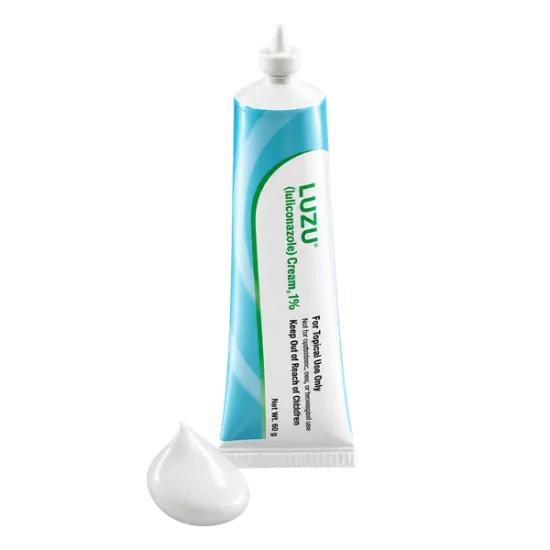
I used Luzu for a flaky patch on my ankle that had been there for about two weeks. The itch settled after several days, and the scaly border gradually faded. I was careful to keep the area dry after showering, which seemed to make a difference.
Luzu is intended for people with localized fungal skin infections such as athlete’s foot, jock itch, and ringworm. Its antifungal action helps clear the infection while easing scaling, itch, and redness.
Overview
Luzu contains luliconazole 1%, an antifungal that disrupts the fungal cell membrane in affected skin.
Dosage and administration
Use Luzu as a thin film on the affected skin and the surrounding area. The regimen for the chosen strength is confirmed with a healthcare professional before starting.
A practical application routine includes:
- Wash the affected area gently and dry it carefully.
- Apply a thin, even layer of cream to the affected skin and nearby skin.
- Wash hands after application unless the hands are being treated.
- Allow the cream to absorb before putting on socks, clothing, or footwear.
- Use the cream for the full planned course, even if itching improves early.
Avoid contact with the eyes, mouth, inside the nose, and genital mucous membranes. Do not apply Luzu to broken skin unless a prescriber has specifically advised it. Covering treated skin with airtight dressings, plastic wrap, or tight bandages can increase irritation and absorption.
Formulation
Luzu is a topical cream containing luliconazole 1%. Luliconazole belongs to the azole antifungal class and is intended for use on the skin only. It targets dermatophytes, a group of fungi that commonly infect the outer skin layer, hair, and nails.
The cream is used for short-term treatment of superficial fungal infections, including:
- Athlete’s foot, also called tinea pedis
- Jock itch, also called tinea cruris
- Ringworm of the body, also called tinea corporis
- Localized itching, flaking, cracking, or redness caused by dermatophyte infection
Fungal rashes often have a scaly edge and may gradually expand outward. A rash that is painful, blistering, weeping, or associated with fever needs prompt medical assessment because it may not be a simple fungal infection.
How it affects the body
Luliconazole blocks an enzyme called lanosterol 14-alpha-demethylase. This enzyme helps fungi produce ergosterol, a key component of the fungal cell membrane. Without enough ergosterol, the membrane becomes unstable and the fungus cannot grow normally. [1]
The action is local. Only a small amount is expected to enter the bloodstream when the cream is used on limited areas of intact skin as directed. This makes topical therapy useful when infection is confined to the skin rather than affecting nails, scalp, or widespread body areas.
Azole creams work against fungi. They do not treat bacterial skin infections, viral rashes, eczema, psoriasis, or allergic contact dermatitis. Using an antifungal on the wrong type of rash can delay appropriate treatment.
Therapeutic indications
The cream is used for short-term treatment of superficial fungal infections, including:
- Athlete’s foot, also called tinea pedis
- Jock itch, also called tinea cruris
- Ringworm of the body, also called tinea corporis
- Localized itching, flaking, cracking, or redness caused by dermatophyte infection
Common mistakes
- Applying a thick layer. More cream does not clear the fungus faster and can leave skin greasy or irritated.
- Stopping as soon as itching settles. Symptoms may improve before the fungal burden has cleared.
- Treating only the most visible spot. Dermatophytes can extend slightly beyond the sharp edge of the rash.
- Applying moisturizers, fragranced body products, or medicated creams immediately over Luzu. This can dilute the product or aggravate sensitive skin.
- Using a steroid cream on a suspected fungal rash without a confirmed plan. Steroids can reduce redness while allowing the fungal infection to spread.
- Reusing damp socks, shoes, or towels. Persistent moisture supports fungal survival.
One detail patients often miss is footwear drying time. Alternating shoes and allowing each pair to dry completely can reduce the damp environment that helps athlete’s foot recur.
Reasons not to use it
- Skin with a known allergy to luliconazole
- Eyes, mouth, or other mucous membranes
- Large areas of severely damaged or burned skin without prescriber direction
- A rash that may be bacterial, viral, or inflammatory rather than fungal
- Scalp or nails when the infection requires a treatment that can reach those sites
Luliconazole has low absorption through healthy skin, so clinically significant interactions are not expected in routine topical use.
When this is not for you
Luzu is not for you if you have had an allergic reaction to luliconazole or another ingredient in the cream.
Pregnancy and breastfeeding require individualized medical advice because data for topical luliconazole exposure in these settings are limited. Keep the cream away from an infant’s mouth and avoid applying it to the breast area if breastfeeding.
Still, tell the prescriber about other creams, medicated ointments, or skin treatments used on the same area. Combining several products can increase irritation or make it harder to judge what is helping.
Possible side effects
Most people tolerate luliconazole cream well when it is applied to a limited skin area. Mild application-site reactions can occur, including burning, stinging, itching, redness, dryness, or irritation. These symptoms can be difficult to separate from the infection itself during the first few applications.
Stop using the cream and seek medical assessment if you develop marked swelling, intense burning, blistering, hives, spreading redness, or a new widespread rash. These may signal irritation, allergic contact dermatitis, or a different skin condition.
Comparison
Topical antifungal treatment is usually appropriate when the infection is limited to small skin areas. Oral antifungal therapy may be considered for extensive disease, repeated relapse, scalp involvement, or fungal nail infection.
| Treatment approach | Main role | Practical limitation |
|---|---|---|
| Luliconazole cream | Localized dermatophyte infections of the skin | Does not treat scalp or nail infection well |
| Other topical antifungals | Superficial fungal rashes | Treatment schedules and response can differ |
| Oral antifungal therapy | Extensive, recurrent, scalp, or nail infection | Has more interaction and monitoring considerations |
Luzu’s advantage is targeted treatment with minimal systemic exposure. The limitation is equally practical: a cream cannot reliably reach infection inside a nail plate or deep within hair follicles. Cochrane’s review of topical treatments for tinea infections found that topical antifungals improve mycological cure for tinea corporis and tinea cruris, though treatment choice still depends on the infection site and extent. [2]
What doctors say
In dermatology practice, the biggest reason an antifungal cream appears to fail is not resistance. It is usually an incorrect diagnosis, inconsistent application, early discontinuation, or repeated exposure from damp footwear and shared surfaces.
Doctors often look at the distribution of the rash. Athlete’s foot commonly affects toe webs and soles. Jock itch tends to involve the groin crease and upper inner thighs. Ringworm often has an advancing scaly border. These patterns guide treatment, yet microscopy or fungal testing may be useful when the rash recurs or looks unusual.
WHO identifies fungal diseases as an increasing public-health concern, especially where diagnosis and access to appropriate antifungal treatment are delayed. [3] For uncomplicated localized dermatophyte infection, topical therapy remains a sensible first approach.

Common questions
Can Luzu be used with cosmetics, sunscreen, or other topical products?
Luzu can be used in a skincare routine, though it should be allowed to absorb on clean, dry affected skin before another product is applied nearby. Heavy moisturizers, oils, fragranced cosmetics, and exfoliating acids may irritate an already inflamed area or create a barrier over the cream. The FDA’s 2023 prescribing information describes Luzu as a topical treatment for limited skin areas, which supports keeping the application site simple during treatment. [4] Sunscreen may be used on exposed skin once the cream has absorbed, provided the treated area is not raw or irritated.
What should I do after a missed application?
Apply Luzu when you remember, unless it is close to the time of the next planned application. Do not apply a double layer to make up for a missed use, since excess cream increases mess and irritation without improving antifungal action. Health Canada’s 2023 medication-safety advice emphasizes avoiding dose doubling after a missed medicine dose. Keep the next application within the established routine.
Is Luzu suitable for older adults?
Older adults can use topical antifungal cream when it is appropriate for the diagnosed infection. Skin may be thinner, drier, or more easily irritated with age, so a thin layer and close attention to burning or redness are sensible. The 2023 FDA prescribing information does not identify a separate topical regimen solely on the basis of age. Older adults with diabetes, poor circulation, numbness in the feet, or recurrent fissures should have persistent foot problems assessed promptly.
How long does a course last, and is long-term use acceptable?
Luzu is intended for a defined short treatment course rather than indefinite maintenance use. The appropriate duration depends on the infection site, the extent of the rash, and clinical response. EMA guidance on topical products, published in 2018, emphasizes that the amount applied and the treated surface area can affect local exposure. Continued or repeated use without reassessment is not the right approach when a rash does not clear, returns quickly, or spreads.
Does Luzu cause burning or stinging?
Yes, mild burning or stinging at the application site can occur, especially on cracked skin or in moist areas such as between toes or skin folds. This reaction is usually mild and short-lived, but worsening pain, swelling, blistering, or a spreading rash requires stopping treatment and obtaining medical advice. WHO’s 2022 fungal priority pathogens report reinforces the value of accurate diagnosis when a presumed fungal condition does not respond as expected. A cream should not be pushed through severe irritation.
Can I drive, concentrate, or work with machinery while using Luzu?
Luzu is applied to the skin and is not expected to impair alertness, coordination, concentration, or driving ability. The cream should be washed off the hands after application unless the hands are the treatment area, preventing accidental transfer to the eyes. The FDA’s 2023 label describes low systemic exposure with topical use on limited skin areas. If the treated rash is painful, affects the feet, or makes walking difficult, the infection itself may affect work comfort more than the cream.
Do you offer anonymous delivery?
Your order will be securely packed and shipped within 24 hours. This is exactly what your package will look like (images of an actual item sent). It has the size and look of a regular private letter (24x11x0.7 cm) and its contents cannot be seen.
Customer Feedback on Luzu
I applied it to athlete’s foot between my toes and noticed less burning by the end of the first week. The cream did not sting much, but I had to remember to dry between my toes before using it. Wearing the same damp running shoes had clearly been part of my problem.
I used the cream for a red itchy area in a skin fold, but it became more sore after several applications. My clinician later said it was not the type of fungal rash this cream was meant for. The experience taught me not to assume every itchy rash is the same.
I treated a ring-shaped rash on my forearm and continued the routine after the itching improved. It took patience because the discolouration remained longer than the active scaling. The skin was clear by the end of the course, though I avoided scented lotion on that area while using the cream.
Sources
- U.S. Food and Drug Administration (2023). LUZU (luliconazole) cream, 1%: Prescribing Information.
- Cochrane (2012). Topical antifungal treatments for tinea cruris and tinea corporis.
- World Health Organization (2022). WHO fungal priority pathogens list to guide research, development and public health action.
- U.S. Food and Drug Administration (2023). LUZU (luliconazole) cream, 1%: Full Prescribing Information.