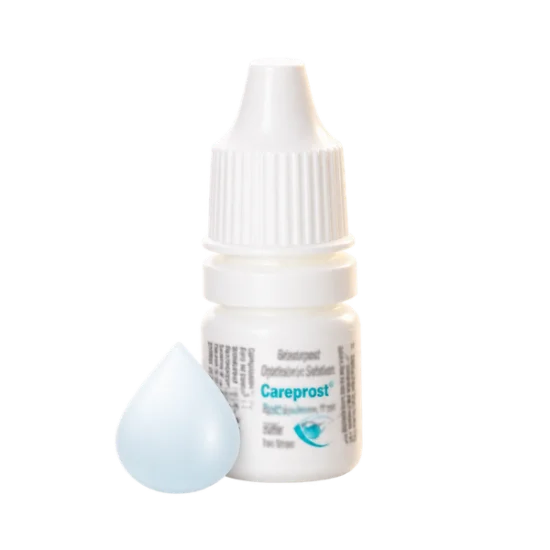
My lashes looked darker and noticeably longer after a while. I had mild redness during the first week, so I used less liquid and became more careful about keeping it on the upper lash line.
Bimatoprost prolongs the active growth phase of eyelash follicles, although results require regular application and may fade after treatment stops. The cosmetic effect is most noticeable in people with sparse or short lashes, though individual response varies.
Overview
Careprost is an ophthalmic solution containing 0.03% bimatoprost for adults seeking fuller, darker, longer-looking eyelashes.
Dosage and administration
The dose is decided individually, taking age, other medicines and health conditions into account. A clinician may select the regimen according to ocular history, sensitivity, current eye treatment, and the reason for use.
For lash enhancement, the usual clinical method involves a thin application to the upper eyelid margin, generally in the evening:
- Remove contact lenses before application.
- Clean the face and remove eye makeup.
- Place the prescribed amount onto a sterile applicator.
- Draw the applicator along the upper lash line from the inner corner toward the outer corner.
- Blot excess liquid from the eyelid without rubbing the eye.
- Repeat on the other upper eyelid with a clean applicator.
- Do not apply the solution to the lower lash line.
Careprost Eye Drop should not be poured directly into the eye for cosmetic lash use unless an ophthalmologist has prescribed it for an eye-pressure condition. Direct ocular administration can produce redness, irritation, or an unwanted reduction in intraocular pressure.
Visible lash changes usually develop progressively. Some people notice early changes after several weeks, while fuller results may take longer with regular use.
If an application is missed, do not apply extra solution the next morning. Resume the next planned application. Doubling the amount does not accelerate the eyelash cycle and may increase irritation or pigmentation.
One practical detail is easy to miss: the bottle tip should never touch the eyelashes, eyelid, fingers, or any other surface. Contact can contaminate the remaining solution.

Formulation
Active ingredient profile
Bimatoprost ophthalmic solution 0.03% was developed for eye-pressure management in conditions such as ocular hypertension and open-angle glaucoma. Its effect on eyelashes was observed during ophthalmic treatment, leading to interest in its ability to increase lash length, thickness, and pigmentation. The same pharmacological activity explains why bimatoprost is associated with both eye-pressure reduction and eyelash growth.
Bimatoprost may affect pigmentation in tissues exposed to the medicine. The most visible cosmetic changes can include darker eyelashes and, in some people, darker skin along the eyelid margin.
How it affects the body
Bimatoprost appears to prolong the anagen phase in eyelash follicles. A longer growth phase allows each lash to remain attached for more time, which can produce longer and fuller eyelashes over several weeks. Follicle activity and local microcirculation may also contribute to the change in lash appearance, although the exact mechanism of cosmetic eyelash growth is not fully defined.
Bimatoprost is not a pigment dye. It changes the behaviour of the follicle, so the result develops gradually rather than immediately.
Clinical ophthalmology literature describes bimatoprost as a prostamide that can influence prostaglandin-sensitive pathways in ocular tissues and adnexal structures [1].
The effect does not permanently alter the hair follicle. New lashes gradually return toward their untreated appearance after regular application ends, because eyelashes continue to complete their natural growth and shedding cycle.
Therapeutic indications
Careprost is intended for adults seeking fuller, darker, longer-looking eyelashes. Its bimatoprost solution prolongs the active growth phase of eyelash follicles; results require regular application and may fade after treatment stops.
Common mistakes
Several application habits can reduce tolerability or create uneven results:
- Applying the solution to both upper and lower lash lines.
- Using the bottle tip directly against the eyelid.
- Reusing a contaminated applicator.
- Applying extra solution after a missed evening.
- Continuing despite eye pain or visual changes.
- Wearing contact lenses during application.
- Applying makeup before the solution has dried.
- Using Careprost alongside another prostaglandin eye drop without medical direction.
- Expecting visible results after only a few applications.
- Stopping and restarting frequently, which makes the lash cycle difficult to judge.
One subtle mistake is wiping the upper lash line immediately after application. This can remove much of the intended dose before it reaches the follicle area. Blot only visible excess liquid that has migrated beyond the target line.
Another is applying the solution while wearing eye makeup. Makeup residue can interfere with contact between the solution and the lash margin, while rubbing to remove it may increase eyelid irritation.
Reasons not to use it
- A known allergy to bimatoprost or any component of the ophthalmic solution.
- Active eye infection, significant eyelid inflammation, or untreated conjunctivitis.
- Recent eye surgery or an unstable eye-pressure condition.
- A history of uveitis, macular oedema, or recurrent inflammation inside the eye.
- Known retinal disease or a high risk of macular oedema.
- Current use of prostaglandin-related eye drops or multiple pressure-lowering medicines.
- Pregnancy or breastfeeding, unless an eye-care professional has assessed the potential benefit and risk.
- Previous serious reaction to bimatoprost, latanoprost, travoprost, or a related ophthalmic medicine.
People with glaucoma, ocular hypertension, aphakia, or a damaged posterior lens capsule need special caution because bimatoprost can affect intraocular pressure and may increase the risk of macular complications in susceptible eyes. The European Medicines Agency describes these ophthalmic warnings in the product information for bimatoprost-containing treatments [3].
When this is not for you
Careprost is not suitable for everyone. NOT for you if you have an active eye infection, uncontrolled eye disease, or a known allergy to bimatoprost until a clinician advises otherwise.
Do not apply Careprost over irritated skin. Avoid use immediately after cosmetic eyelid procedures until the area has healed and an eye-care professional confirms that application is appropriate.
Possible side effects
Bimatoprost can cause local effects around the eye. The likelihood depends on the amount used, application accuracy, treatment duration, ocular sensitivity, and whether the solution reaches the eye or surrounding skin.
Possible effects include:
- Eye redness from conjunctival hyperemia.
- Itching, burning, dryness, or watering.
- Darkening of eyelid skin.
- Darkening of the iris, especially with prolonged ocular exposure.
- Uneven eyelash growth if application is inconsistent.
- Temporary blurred vision after accidental eye contact.
- Periocular hollowing or changes in the appearance of tissue around the eyes in susceptible users.
- Eyelid inflammation or irritation.
Iris pigmentation deserves special attention. Brown pigmentation can be permanent, while skin darkening around the eyelid may lessen after stopping treatment, although it may not disappear completely in every person. The FDA prescribing information for bimatoprost ophthalmic products describes these pigmentary risks and recommends monitoring during treatment [2].
Precautions for contact lens wearers
Contact lenses should be removed before applying Careprost. Lenses can absorb benzalkonium chloride or other preservatives used in ophthalmic solutions, which may irritate the cornea or damage soft lens material.
Wait at least 15 minutes before reinserting lenses unless an eye-care professional has given different instructions. Keep the solution away from the lens itself.
A person using pressure-lowering eye drops should not add bimatoprost casually. Combining ocular medicines can alter intraocular pressure and increase the chance of adverse effects.
Comparison
Careprost and Latisse contain the same active substance, bimatoprost, at the 0.03% concentration associated with eyelash-growth treatment. Their clinical positioning, authorization history, presentation, and prescribing information can differ by jurisdiction.
| Product or approach | Active ingredient and role | Main clinical distinction |
|---|---|---|
| Careprost | Bimatoprost 0.03%; prostamide ophthalmic solution | Used under individualized clinical direction for ophthalmic or lash-related treatment |
| Latisse | Bimatoprost 0.03%; eyelash-growth formulation | Specifically positioned in the United States for acquired eyelash hypotrichosis |
| Other lash products | May contain cosmetic conditioners or non-bimatoprost ingredients | Usually support lash appearance without the same prostamide mechanism |
Latisse is associated with a standardized eyelash-growth indication in United States prescribing information. Careprost contains the same active ingredient and concentration, but the appropriate use depends on the clinical direction and regulatory framework applying to the product.
The key comparison is pharmacological, not cosmetic packaging. Products with bimatoprost can produce stronger follicle effects than ordinary lash conditioners, along with a greater possibility of ocular or periocular adverse effects.
What doctors say
In clinical practice, ophthalmologists usually separate two questions: whether bimatoprost can influence eyelash growth, and whether it is appropriate for a specific person. The first is supported by the pharmacology of the active ingredient. The second depends on eye health, medication history, pigmentation risk, and the reason for treatment.
A physician would usually set realistic expectations. The effect is gradual, lash density varies between individuals, and treatment does not create unlimited new follicles. Continued use may be needed to maintain the appearance, while stopping allows the lashes to return gradually toward their baseline cycle.
For people already using glaucoma treatment, the prescribing clinician may need to monitor intraocular pressure. Bimatoprost has a legitimate ophthalmic role, and the World Health Organization includes prostaglandin-related medicines within the wider framework of essential eye-care treatment principles [4].
Common questions
What should I do if the expected eyelash result does not appear?
Allow enough time for the eyelash growth cycle before judging the response. Clinical information for bimatoprost eyelash treatment describes progressive improvement rather than an immediate change, and inconsistent application can make the result difficult to assess. The FDA-approved eyelash-growth information for bimatoprost, issued in 2008, was developed around regular use and follow-up, with safety review focused on ocular and periocular effects [5]. If there is no meaningful change after a clinically appropriate trial, an ophthalmologist can assess application technique, eyelid disease, thyroid-related hair changes, nutritional problems, or another cause of sparse lashes. Follow-up can also identify whether continued treatment is appropriate.
Which condition rules out Careprost?
A known allergy to bimatoprost is a direct reason to avoid it. Active eye inflammation, untreated infection, macular oedema, or recent eye surgery also requires medical assessment before use. Health Canada's 2019 safety information for ophthalmic medicines treats significant ocular inflammation and hypersensitivity as clinically relevant precautions. A history of glaucoma treatment does not automatically rule out bimatoprost, but it does make individualized eye-pressure monitoring more relevant.
Can Careprost cause eyelid or iris darkening?
Yes. Bimatoprost may darken the skin of the eyelid or the iris, with iris pigmentation potentially permanent. The risk is related to exposure and individual susceptibility, and accidental spreading onto nearby skin can produce uneven darkening. The EMA's 2010 product information for bimatoprost-containing ophthalmic preparations describes pigmentation changes as a known safety issue, so new colour changes should be documented and discussed with an eye-care professional.
How does Careprost differ from Latisse?
Careprost and Latisse use the same active ingredient, bimatoprost, at 0.03% in the formulations described for eyelash growth. The major differences relate to product presentation, labeling, authorization, and the regulatory setting in which each product is prescribed or supplied. The FDA's 2008 prescribing information describes Latisse as a bimatoprost product for acquired eyelash hypotrichosis, while bimatoprost ophthalmic solution also has an established eye-pressure indication. The active substance is therefore the closest point of comparison, not the brand name.
How long does one application keep working?
A single application does not produce a visible all-day cosmetic effect in the way a mascara does. Bimatoprost acts through the follicle over repeated applications and the eyelash growth cycle, so its influence develops gradually and is not measured as a fixed number of hours. The European Medicines Agency's 2010 product information explains prostaglandin-related ocular effects in terms of biological tissue response rather than immediate cosmetic coverage. Missing an evening does not require a double application the next day.
Do diet, exercise, or daily habits affect the result?
No specific diet or exercise program has been established to make bimatoprost grow eyelashes faster. General nutrition, adequate protein intake, and management of conditions that cause hair shedding support normal hair biology, but they do not replace the local action of bimatoprost. Eye rubbing, poor makeup removal, contaminated applicators, and application to inflamed skin can hinder tolerability. Health Canada's 2019 patient-safety principles support reducing avoidable contamination and preventing unnecessary ocular exposure during topical eye treatment.
Can older adults use Careprost?
Older adults may use bimatoprost only when the expected benefit and eye-related risks have been assessed individually. Age can be accompanied by dry eye, glaucoma, cataract surgery, macular disease, multiple eye drops, or changes in eyelid skin that affect tolerability. The WHO's 2019 guidance emphasizes that eye-care decisions in older adults should account for coexisting eye disease and concurrent treatment. A clinician may also review other medicines and decide whether intraocular pressure or retinal monitoring is appropriate.
Do you offer anonymous delivery?
Your order will be securely packed and shipped within 24 hours. This is exactly what your package will look like (images of an actual item sent). It has the size and look of a regular private letter (24x11x0.7 cm) and its contents cannot be seen.
Customer Feedback on Careprost
The change was gradual rather than dramatic. I liked the fuller look, but one eye seemed to respond faster than the other, and I had to pay attention to applying the same way on both sides.
I noticed stronger lashes, but my eyes felt dry and looked red after applications. The cosmetic result was useful, yet the irritation meant I could not continue comfortably.
Sources
- PubMed (2010). Bimatoprost 0.03% topical solution for the treatment of eyelash hypotrichosis in subjects with inadequate or not enough eyelashes.
- U.S. Food and Drug Administration (2008). Lumigan (bimatoprost ophthalmic solution) Prescribing Information.
- European Medicines Agency (2010). Summary of Product Characteristics (SmPC) — bimatoprost.
- World Health Organization (2019). WHO Package of Eye Care Interventions.
- U.S. Food and Drug Administration (2018). Latisse (bimatoprost ophthalmic solution) Prescribing Information.